
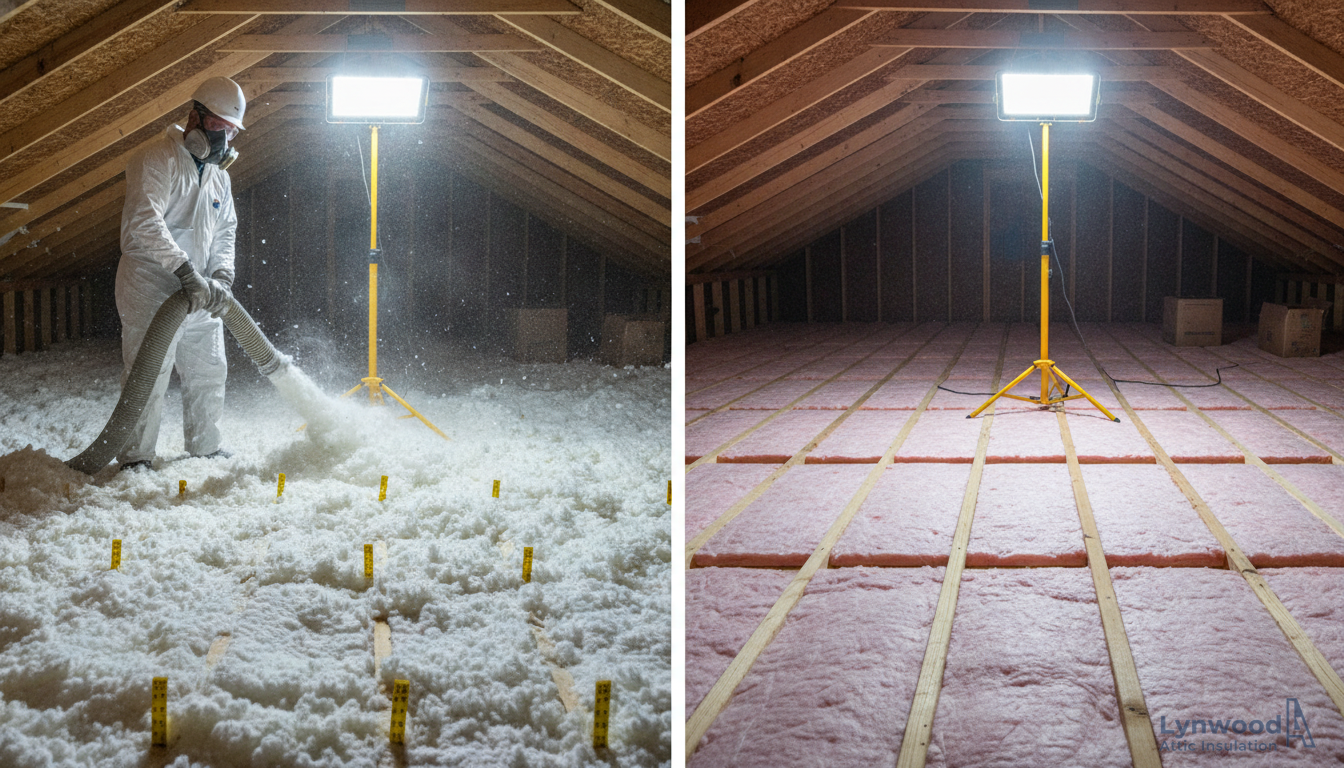
Two Great Options — But Which Is Right for Your Attic?
When Lynwood homeowners call us about upgrading their attic insulation, one of the first questions we get is: "What's the difference between blown-in and batt insulation, and which one should I choose?" It's a great question. Both materials can bring your attic up to the R-38 to R-60 range recommended by the California Energy Commission for Southern California homes, but they perform differently depending on your attic's layout, age, and existing conditions.
This guide will walk you through the key differences so you can have an informed conversation when it's time to schedule your attic insulation installation.
What Is Blown-In Insulation?
Blown-in insulation — also called loose-fill insulation — consists of small particles of fiberglass or cellulose that are blown into the attic using a powerful machine and flexible hose. The loose material flows around obstacles like pipes, wiring, and structural framing, filling irregular spaces that pre-cut batts simply cannot reach.
There are two main types of blown-in material:
- Cellulose: Made from recycled paper products treated with fire retardants. Cellulose is an eco-friendly option with excellent thermal performance and good sound-dampening characteristics. It does settle slightly over time, but we account for this by installing to a slightly greater initial depth.
- Fiberglass loose-fill: Made from spun glass fibers. Fiberglass settles less than cellulose and is naturally moisture-resistant, making it a strong choice for attics with ventilation or humidity concerns.
Our professional blown-in insulation service uses powerful blowing equipment to distribute loose-fill material evenly across the entire attic floor. We place depth gauges throughout the space before we begin so we can verify the R-value achieved once the job is complete.
What Is Batt Insulation?
Batt insulation consists of pre-cut rectangular panels of fiberglass or mineral wool, designed to fit between standard wall studs and attic joists. Batts come in widths that correspond to common framing dimensions — typically 16 or 24 inches on center — and in a range of thicknesses that correspond to different R-values.
Batt insulation is a reliable and straightforward choice when:
- The attic has uniform, unobstructed joist bays with standard spacing
- The attic is being insulated for the first time in a newly built or freshly remodeled home
- Budget is a primary consideration and the attic layout allows for efficient installation
The limitation of batts becomes apparent in older Lynwood homes where joist spacing is irregular, where pipes and wiring create obstructions, or where previous insulation has left the space difficult to work in. In these situations, batts leave gaps and voids that compromise the overall thermal performance of the installation.
Blown-In Insulation vs. Batt: Side-by-Side Comparison
- Coverage: Blown-in fills every gap, corner, and irregular space. Batts are best in uniform, open joist bays.
- Speed: Blown-in is generally faster to install over large attic areas. Batts require more hands-on fitting and cutting.
- Performance in older homes: Blown-in significantly outperforms batts in homes with complex attic layouts, which includes many Lynwood-area homes built in the 1950s through 1970s.
- Topping off existing insulation: Blown-in is the preferred method for adding insulation on top of existing material to bring R-values up to code.
- Moisture resistance: Fiberglass blown-in and fiberglass batts are both moisture-resistant. Cellulose is more sensitive to moisture.
- Eco-friendliness: Cellulose blown-in is made from recycled materials, making it the most environmentally friendly option.
Do You Need to Remove Old Insulation First?
Before we can recommend an insulation type, we assess the condition of what's already in your attic. If existing insulation is water-damaged, contaminated by rodents or pests, or so compressed that it's no longer performing, it needs to come out before new material goes in. Our insulation removal service clears the attic safely and cleanly so the new installation can deliver its full performance potential.
We frequently see attics in Cudahy, Willowbrook, and Watts where decades of settling, pest activity, and moisture have left the original insulation nearly useless. Removing it and starting fresh is the right call in these situations.
Always Combine Insulation With Air Sealing
Regardless of which insulation type you choose, air sealing should always come first. Gaps around recessed lights, plumbing penetrations, and framing junctions allow conditioned air to flow right past your insulation. Our attic air sealing service addresses these bypasses before insulation is installed, ensuring the complete system performs as efficiently as possible.
Ready to Get Started?
Lynwood Attic Insulation serves homeowners throughout Lynwood and the surrounding area, including blown-in insulation in South Gate, blown-in insulation in Compton, and blown-in insulation in Paramount. We're open Monday through Sunday, 8:00 AM to 6:00 PM. Call us at (424) 567-8928 or email [email protected] to schedule your free attic assessment today.